


Page 14 - Sajo ENG
P. 14
city fathers had already outgrown the Town Hall by around 1920,
                                                                            so much so that they wanted to have it demolished (“The bleak
                                                                            and spiritless Viennese Neo-classical details bear absolutely no
                                                                            Hungarian cultural value,” was the succinct and deucedly harsh
                                                                            description of the building by József Borsos.) In any case, it’s
                                                                            time to forget this lopsided myth. And anyone looking for a true
                                                                            experience of Classicist spaces should go to Vienna, London
                                                                            or St Petersburg, or at least to Balatonfüred; well, just to one
                                                                            street in the latter.


                                                                            I think the coming of age of our city and of our architecture
                                                                            began with the large-scale, Hungarian Art Nouveau County Hall
                                                                            designed by Zoltán Bálint and Lajos Jámbor; then it culminated
                                                                            with József Borsos’ majolica-decorated police station and
                                                                            crematorium in the Big Forest, and was enriched for years with
                                                                            works that branched off Modernism: buildings by Ferenc Jost,
                                                                            Tibor Vári Szabó, Gyula Rimanóczy, Tibor Hübner, Nándor Körmendi
                                                                            as well as Jenő Lechner and Pál Szontágh, who designed the
                                                                            Heroes’ Mausoleum, and by Jenő Padányi-Gulyás, the designer
                                                                            of the Hungarian General Credit Bank in Piac Street. All this was
                                                                            executed at a European scale. The taste manifest in these works
                                                                            is a source of delight even today, and their existence is fortunate
                                                                            in this city that has suffered so much, in fact far too much.


                                                                            How can something so obvious, something that you come across
                                                                            every day and shines like the sun, be so unnoticed? Here I’m not
                                                                            referring to the strong accents of Gaudí or Hundertwasser, Renzo
                                                                            Piano or Jean Nouvel, to their landscape-creating architectural
                                                                            signs. Nor am I referring to the attractive skyscrapers in Shanghai,
                                                                            designed by Sajó’s contemporary, László Hugyecz. István Sajó’s
                                                                            art is discreet but it draws attention to its own sophistication
                                                                            through its ingenuity and noble proportions.


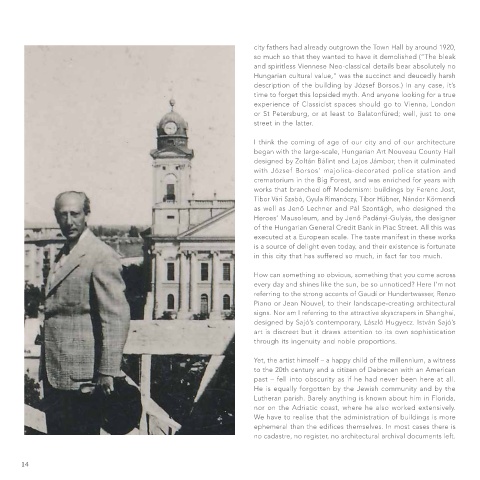
                                                                            Yet, the artist himself – a happy child of the millennium, a witness
                                                                            to the 20th century and a citizen of Debrecen with an American
                                                                            past – fell into obscurity as if he had never been here at all.
                                                                            He is equally forgotten by the Jewish community and by the
                                                                            Lutheran parish. Barely anything is known about him in Florida,
                                                                            nor on the Adriatic coast, where he also worked extensively.
                                                                            We have to realise that the administration of buildings is more
                                                                            ephemeral than the edifices themselves. In most cases there is
                                                                            no cadastre, no register, no architectural archival documents left.


       14

